

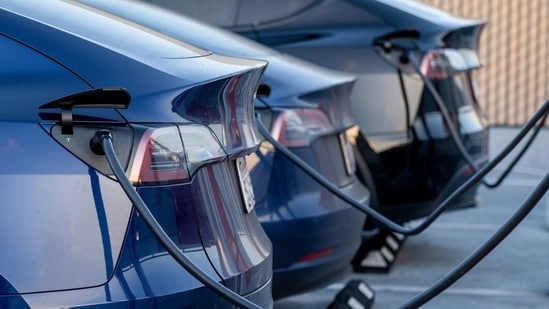
Richard Symons recently took his five-year-old Tesla Model 3 on a 260-mile road trip across England without having to stop for a charge.
A new electric vehicle could make the trip no-problem. But Symons’s car—which he has affectionately nicknamed “Miles”—has logged 247,000 miles and is still up for frequent long-stance drives.
Symons, the owner of a U.K.-based used-car sales company that specializes in EVs, has found that the batteries that power these cars continue to perform well even after several hundred thousand miles. This has come as a welcome surprise to him and other EV enthusiasts.
“They are proving themselves to be exceptionally reliable,” Symons said.
After five years on the road, the average EV will still be able to drive up to 95% of its original range, according to Recurrent, a data-science company that provides a battery-monitoring tool for EVs—better than many in the auto industry expected.
Consumers in the mass market have yet to develop trust in EV batteries, according to Jessica Caldwell, head of insights at car-shopping resource Edmunds. “There still is a lot of trepidation amongst buyers,” she said.
Potential new car buyers’ fear of having to pay for a battery replacement is the number one reason they choose to steer clear of EVs, according to a 2025 survey from industry research firm AutoPacific.
When early EVs hit the market, buyers’ concerns were well-founded. Roughly one in 12 EVs built from 2011 to 2016 have had to have battery replacements. But new data shows that more modern EVs are doing better so far. Among EVs built from 2022 on, 0.3% have had battery replacements, according to a 2025 study from Recurrent.
As battery technology has advanced, EVs have avoided problems like the ones that plagued the original Nissan Leaf when it hit the market in 2010, for example. Those cars lacked the battery-cooling technology that is in newer EVs, and they made headlines for wearing down quickly.
Buyer perception hasn’t quite caught up, according to Scott Case, co-founder and chief executive of Recurrent.
“I think that people ought to have a lot more confidence than they do,” Case said.
The newest battery-powered EVs have lifespans comparable to internal-combustion-engine vehicles, even when driven more miles, according to Viet Nguyen-Tien, a research officer at the London School of Economics who focuses on EVs.
Improvements in car batteries’ chemical contents, battery-management systems and thermal regulation have been the difference in making batteries last longer and cost less, Nguyen-Tien said. Battery prices have fallen more than 90% since 2010, according to a BloombergNEF report from late last year.
Industry analysts say battery-replacement costs are also improving as more EVs are designed for repairability in the long-haul.
An out-of-warranty battery replacement can cost anywhere from $5,000 to $16,000, depending on the manufacturer, according to Recurrent. But many EV manufacturers have shifted to allow smaller components of their battery packs to be repaired, which can allow owners to avoid the full costs of a battery replacement, Case said.
EV batteries aren’t without their challenges, though. A battery that is frequently fast-charged with high power loses its range, on average, at twice the rate of a battery charged at a lower power, according to telematics company Geotab.
Frequently charging a battery to 100%, or letting it rest at 0% for extended periods, can also reduce range long-term. And EVs regularly deliver less range in extreme cold or heat.
In the U.S., consumers have yet to fully embrace electric cars. America’s enthusiasm for EVs has waned after the Trump administration ended EV subsidies and regulations driving a more electric new-car market. EV sales are down 25% so far in 2026, compared with last year, according to data from Motor Intelligence.
But industry analysts don’t expect the U.S. slowdown on EVs to last forever. The share of new EVs sold is expected to nearly double to 11% of new-car sales in the U.S. by 2030, according to industry consulting firm AlixPartners.
Globally, EVs already make up 15% of new-car sales and are expected to form nearly a quarter of the global market by 2030, according to AlixPartners.
EV advocates like Ken Yannacci, a market analyst and founder of an EV-ownership and gear website, hope that a clearer picture of exactly how long car batteries can last will help them catch on in the U.S.
“As EVs get a reputation for having that battery longevity, that’s definitely gonna help,” he said.
Write to Ellie Davis at ellie.davis@wsj.com

