

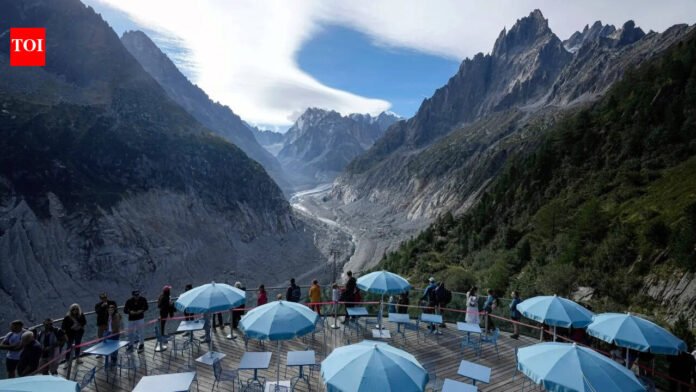
Climate change is increasingly becoming a threat to the snow-clad European Alps, amid initial investigations associating the August 26 Nepal tragedy with rising temperatures.Average temperatures in July, on the Aiguille du Midi peak, in the Mont Blanc range, have more than doubled, from 1.6 C in 1994 to 3.3 C, according to Meteo France, the national weather service.In Lombardy, Italy, Alpine glaciers have reportedly lost more than 40 per cent of their surface area since 1991, according to the region’s glacier service.Europe’s record heat waves this summer have also affected the permafrost that has held parts of the Alpine landscape together for thousands of years. As the frozen ground thaws, cliffs have become more unstable, triggering rock falls from high elevations.“From mid-July onward, we saw an increase in rock falls. We saw areas becoming difficult to access because of glacial retreat and snowmelt on the glaciers, with crevasses opening up and rock collapses making some areas difficult to reach or traverse”, said Stéphane Bozon, deputy mayor in Chamonix-Mont-Blanc, which shares a border with Italy.Bozon, who oversees safety in Chamonix, told AP that the town needs to prepare urgently for “serious scenarios” in which parts of glaciers or mountains could potentially fall towards inhabited areas.“While it used to snow at high altitudes in the past, now it rains”, said Vanda Bonardo, head of the Italian branch of the International Commission for the Protection of the Alps, a non-governmental organisation.“So we’ve also seen the effects on the stability of the terrain”, she said.Rock falls in the Mont Blanc area have reportedly surged as the permafrost that helps bind the steep Alpine rock faces together has been affected by repeated heat waves.“That doesn’t mean that all the rock faces will collapse in the coming years or decades, but quite a number of them are on the verge of becoming unstable and remain stable today only because of the presence of that ice. As the ice changes, we have seen a huge, huge number of rock falls and rock collapses this year”, said Ludovic Ravanel, a researcher at Savoie Mont Blanc University.A collapse is defined as a fall involving more than 100 cubic metres of rock. Ravanel expects the number of such collapses in the Mont Blanc massif this year to “probably reach around 400”. He said this would be about 10 times the level recorded two decades ago.The previous year when conditions came close to this level was 2022, which Ravanel described as the “catastrophic year”, when nearly 300 collapses were recorded.“This has really been one of the defining features of the summer of 2026”, he said.Contains inputs from the Associated Press.

